
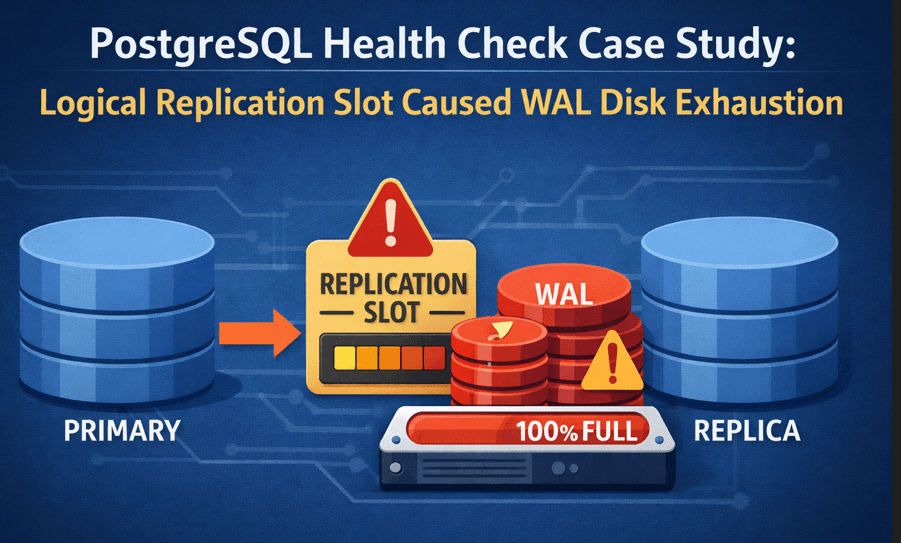
This PostgreSQL health check case study explains how a simple DDL change caused silent WAL accumulation and nearly took down a production database.
The issue was not CPU. It was not query performance. It was not traffic.
It was WAL retention caused by a logical replication slot.
Architecture
- Primary database (source) – OLTP workload
- Logical replication target (subscriber) – separate instance for reporting
- Replication method:
CREATE PUBLICATION/CREATE SUBSCRIPTION - Dedicated replication slot on primary
Important:
Logical replication does NOT replicate DDL changes.
Streaming (physical) replication does.
Logical replication works at row level. Schema changes must be applied manually on both sides.
The Change That Triggered the Incident
On primary:
ALTER TABLE transactions
ADD COLUMN reference_code TEXT;
The same DDL was not applied on the subscriber.
Replication stopped applying changes immediately.
But nothing crashed.
What Happened Internally
- Subscriber failed to apply changes.
- Replication worker started erroring.
- Replication slot on primary remained active.
- WAL segments required by that slot could not be recycled.
- WAL files accumulated continuously.
PostgreSQL will never remove WAL files still required by an active replication slot.
That is by design.
Early Warning Signals (That Were Missed)
1. Replication Slot Still Active
On primary:
SELECT slot_name,
       active,
       restart_lsn,
       pg_size_pretty(pg_wal_lsn_diff(pg_current_wal_lsn(), restart_lsn)) AS retained_wal
FROM pg_replication_slots;
You can inspect slot retention using the pg_replication_slots system catalog.
Output
slot_name        | reporting_slot
active           | true
retained_wal     | 185 GB
The slot was active, but retained WAL was growing continuously.
2. WAL Directory Growth
On the primary server:
du -sh $PGDATA/pg_wal
Output:
210G pg_wal
Disk alerts triggered at 85% capacity.
Without intervention, the server would have stopped accepting writes within a day.
3. Errors in Subscriber Logs
On the logical replication target:
Example log entries:
ERROR:  logical replication target relation "public.transactions"
has different column count from source relation
CONTEXT: processing remote data for replication origin "pg_16384"
And repeatedly:
ERROR:  missing replicated column: "reference_code"
STATEMENT: INSERT INTO public.transactions (...)
The replication worker kept retrying and failing.
4. Primary Server Log Warnings
Primary logs showed:
WARNING:  replication slot "reporting_slot" is preventing removal of required WAL segments
DETAIL:  The slot has retained 180 GB of WAL files.
This is a classic early signal in a PostgreSQL health check.
Why This Is Dangerous
Replication slot retention works by design:
PostgreSQL will not remove WAL files required by an active replication slot, as explained in the official PostgreSQL replication slots documentation.
If the subscriber cannot consume changes:
- WAL retention grows indefinitely
- Disk fills up
- Primary database becomes unavailable
- Production outage occurs
Logical replication makes this risk higher because DDL mismatches are common.
Root Cause
The root cause was simple:
- A DDL change was applied to the primary
- The same DDL was not applied to the logical subscriber
- Logical replication stopped applying changes
- Replication slot retained WAL indefinitely
No automatic schema sync exists in logical replication.
How the Issue Was Fixed
Step 1 – Apply missing DDL on subscriber:
ALTER TABLE transactions
ADD COLUMN reference_code TEXT;
Step 2 – Verify subscription status:
On subscriber:
SELECT * FROM pg_stat_subscription;
Subscription state can be monitored via pg_stat_subscription.
Step 3 – Confirm slot consumption resumed:
On primary:
SELECT slot_name,
       pg_size_pretty(pg_wal_lsn_diff(pg_current_wal_lsn(), restart_lsn)) AS retained_wal
FROM pg_replication_slots;
Retained WAL began decreasing.
Step 4 – Monitor pg_wal directory shrinkage.
System stabilized.
Health Check Controls That Would Have Prevented This
This incident was preventable.
A proper PostgreSQL health check should include:
1. WAL Disk Usage Monitoring
Alert when:
- pg_wal exceeds defined threshold (e.g., 70%)
- WAL growth rate accelerates abnormally
2. Replication Slot Retention Check
Script:
SELECT slot_name,
       active,
       pg_size_pretty(
         pg_wal_lsn_diff(pg_current_wal_lsn(), restart_lsn)
       ) AS retained_wal_size
FROM pg_replication_slots
WHERE slot_type = 'logical';
Alert when retained WAL exceeds threshold (e.g., 10 GB in reporting workloads).
3. Subscription Health Check (Subscriber Side)
SELECT subname,
       status,
       last_msg_send_time,
       last_msg_receipt_time,
       latest_end_lsn
FROM pg_stat_subscription;
Alert if:
- status != 'streaming'
- last_msg_receipt_time is stale
4. Log Monitoring
Both source and target logs must be monitored for:
- logical replication errors
- replication worker restarts
- slot retention warnings
Lessons Learned
- Logical replication does not replicate DDL.
- Active replication slots can silently retain massive WAL.
- Replication being “active” does not mean it is healthy.
- WAL disk alerts are critical for production systems.
- Slot retention size must be part of every PostgreSQL health check.
Streaming vs Logical Replication: Why This Matters
Streaming (physical) replication:
- Block-level
- Replicates DDL automatically
- Lower schema drift risk
Logical replication:
- Row-level
- Does not replicate DDL
- Higher operational risk if schema governance is weak
Choosing logical replication requires stronger monitoring discipline.
Understanding the differences between streaming and logical replication is critical for any serious PostgreSQL health check strategy.
For a deeper breakdown, see our guide on Streaming vs Logical Replication in PostgreSQL.
Preventive Checklist
Before applying DDL on primary:
- Verify whether table participates in logical publication
- Apply DDL to subscriber first (or in controlled order)
- Validate replication health after change
Continuous monitoring should include:
- WAL disk usage
- Replication slot retention
- Subscription state
- Error logs
Final Thoughts
This was not a performance issue. It was not a crash. It was not a traffic spike.
It was silent replication drift.
Without WAL monitoring and replication slot visibility, the primary database would have gone down within hours.
A proper PostgreSQL health check is not just about CPU, queries, or indexes.
It must include:
- Replication health
- Slot retention
- WAL growth patterns
- Log analysis
Because databases rarely fail instantly.
They degrade silently — until storage runs out.
This is a classic signal that should always be covered in a proper PostgreSQL health check.
Author: Fırat Güleç — Principal PostgreSQL DBA
Try pghealth Free Today 🚀
Start your journey toward a healthier PostgreSQL with pghealth.
You can explore all features immediately with a free trial — no agent installation required